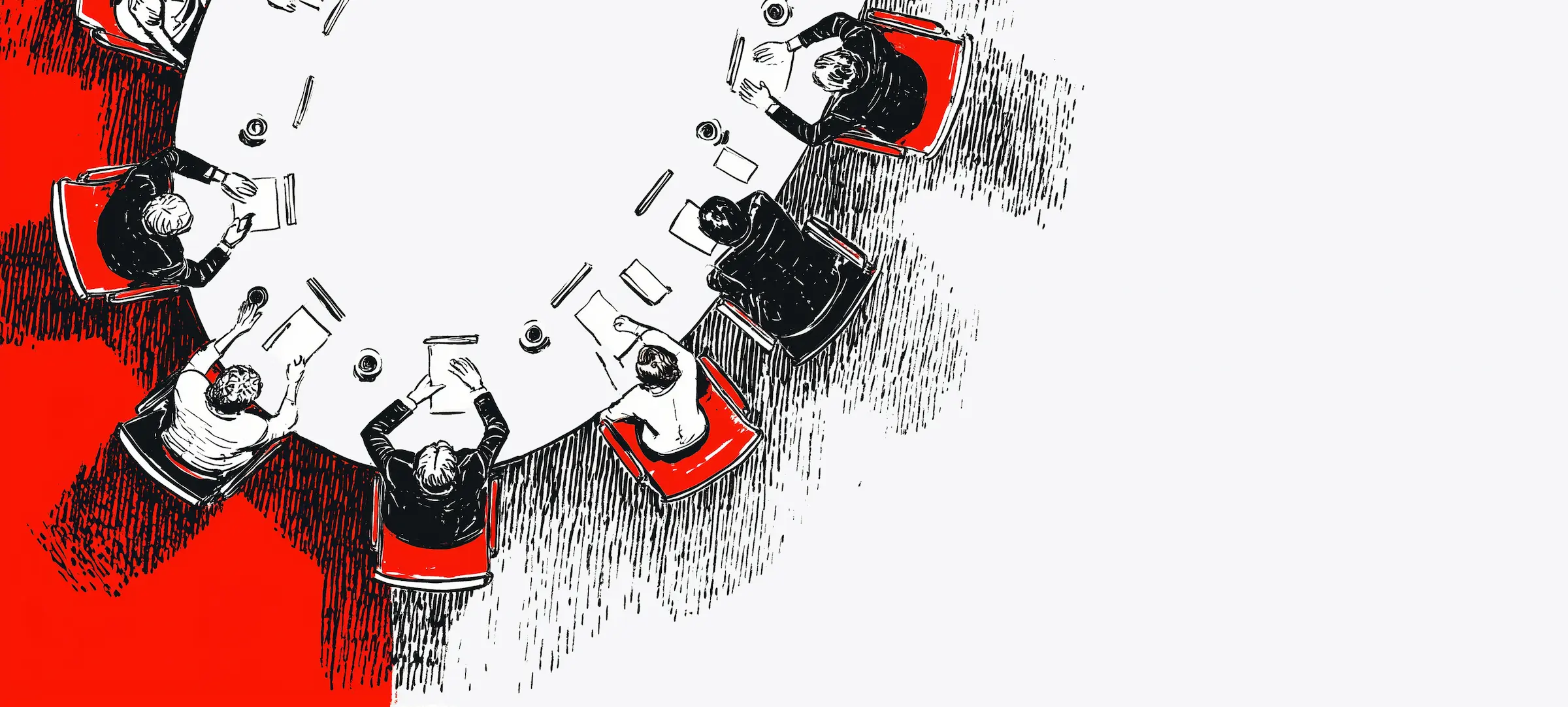


When the Strait of Hormuz lit up this summer, I did something that, on paper, looked absurd. I put a senior defense executive from Northrop Grumman in a room with a treasury director from Wells Fargo, a supply-chain head from Shell, an insurance underwriter, a policy specialist, and a trader. Then I sat the C-suite of a Fortune 500 down at the same table and asked them to listen.
The conventional way to run a community session on a day like that would have been to convene a single function — a CFO-only room to talk treasury exposure, a CPO-only room to talk supply chain, a CISO-only room to talk cyber posture. That is how peer communities have been built for thirty years. I have run those rooms too, they work. But somewhere over the last couple of years, watching disruptions arrive faster than any single function could absorb them, I started running the opposite experiment on purpose: take a problem that does not respect functional borders, and build a room that does not respect them either.
What the chief executives in that room got that afternoon, no consulting deck could have produced. They left less alone.
That last word is the one I want to dwell on, because it is the key to understanding how to best run your community right now.
For a generation, the senior executive's instinct in a crisis was to call McKinsey, or Bain, or a Gartner analyst. The model was simple and lucrative: pay a smart outsider to interview the people who actually know things, synthesize, and present.
With AI, that model is dying. A large language model can now do, in ninety seconds, the work that mid-tier analysts used to bill for at six-figure annual rates. Ask a chatbot what to do about a talent shortage and you will get a list of respectable answers, footnoted, in tidy bullets. But whether those bullets come from a consultant or an LLM, the problem at the top of a large enterprise has almost never been a shortage of information. It has been a shortage of context, and company.
A chatbot does not know the ontology of your organization. It does not know which vice president cannot be told no, which board member is quietly furious, which acquisition is held together with duct tape. Nor can you tell your board that you do not know. You cannot tell your team you are scared. No algorithm fixes that. Another human in the same seat does.
I have come to call this deficit strategic loneliness. It is the condition of the modern professional. And it's why the most impactful group in the modern corporate world is the closed-door peer community. It doesn't matter whether you're the only product manager at a fifty-person startup, the founder in a regulated industry, the senior engineer who is the lone specialist on her team. The community that finds her three peers she can really talk to is the community she will pay for, forever.
I watched the loneliness piece of this clarify in real time when the latest round of tariffs was announced. In my World 50 days running the procurement community, we pulled the chief procurement officers of fifty large enterprizes together within twenty-four hours of the announcement. I had assumed the value would be tactical (playbooks, supplier workarounds, hedging strategies). It was not. The first hour was simply executives looking at each other and exhaling: "You too? Thank God". The actionable insights came after.
Now, most of you are not running C-suite forums. You're running a five-thousand-person Slack, or a paid Discord, or a Circle space, or a Friday newsletter with a comments section. But I think the lesson still travels: The broadcast layer of your community is the least valuable thing you do.
The feed, the AMA, the keynote, the channel with thousands of members is the marketing surface. The actual product is the small room. And your real job is not to host the largest conversation, it is to know which seven members should be in a Zoom together and to make that happen.
The corollary is uncomfortable for anyone who measures success in member counts. Scale is not the metric. Specificity is. A community of a thousand where every member can find their go-to people is worth more than a community of fifty thousand where everyone is shouting into the same room.
The shape of the rooms we are building is changing, too. The old community model was functional and tribal: a CFOs group, a designers' Discord, a founders' Slack. That model assumed problems lived inside silos. They no longer do. Tariffs are a procurement problem and a treasury problem and a geopolitics problem and an HR problem, all at once. The Strait of Hormuz was a defense problem and an insurance problem and a supply-chain problem and a trading problem, all at once. AI is a technology problem and a labor problem and a legal problem and a brand problem. The peer next door, who looks exactly like you and does exactly your job, increasingly cannot help you, because your job is no longer the unit of the problem.
The communities that will matter, I think, are the ones that go horizontal as well as vertical. Function groups will not disappear, there is still real value in the CFO-only room, but the rooms with the highest leverage will be the cross-functional ones, deliberately mixed.
But, designing those rooms is harder than it looks.
The first thing that breaks when you mix functions is vocabulary. A treasury director and a defense analyst do not speak the same dialect. A trader's time horizon is hours; a defense planner's is decades. If you drop them in a room and let them talk, they will speak past each other for forty minutes and conclude that the format does not work. The curator's job is to translate, not just to invite. In the Hormuz session, I spent more time briefing each participant on what the others would hear from them than I spent organizing the room itself. Every participant arrived knowing which two questions the C-suite would actually need them to answer, and in what order. That sequencing is the craft.
The second thing that breaks is trust, because trust does not arrive when the calendar invite says it should. It arrives because of pre-work. Every participant in a horizontal room needs to know, before they walk in, who else will be there, what the confidentiality norms are, what will and will not be recorded, and what the post-room artifact will look like. The community manager who skips this work and hopes the magic happens in the room is the community manager whose room dies in awkward silence.
The third thing that breaks is status. Cross-functional rooms scramble hierarchy in ways that single-function rooms do not. In a CHRO peer group, everyone is roughly equivalent. In a room with a four-star general's former chief of staff, a sovereign-wealth-fund treasurer, and a Series C founder, the status signals collide. Good curation flattens this on purpose: shared anxiety first, expertise second. We started the Hormuz session not with the defense brief but with each participant naming, in one sentence, what was keeping them up that week. By the time the technical content started, the room had already agreed it was a peer group.
The last thing (and the part I am still learning), is that horizontal community design requires the curator to disappear in the room and to be hyper-present outside it.
In the room, the worst thing you can do is moderate. Outside the room, the work is relentless: pre-briefs, post-debriefs, follow-up matches, capturing the insights without exposing the source, deciding who gets invited back. The community manager who wants to be on stage will fail at this. The one who treats themselves as the connective tissue between sessions will build something durable.
The consulting model said: pay us, and we will interview the experts for you. The old community model said: come into the room with people who do your job. The new model says: come into the room with the people whose problems intersect with yours, and let the room reason together.
I know which one I would bet on. It is the one where the people at the loneliest seats in the room finally get to look across the table and see each other, and where the person who built that table understands their job is not to sit at it.

Akhil George builds executive communities. He currently leads the Executive Community at Delphi by Dialectica, an invite-only network of C-suite members and board directors from the world's leading organisations.