

"Because nobody goes to school for B2B marketing." That’s Exit Five’s tag line. By filling that education gap, Exit Five has become the leading community for B2B marketers. Founded by industry veteran Dave Gerhardt, it’s a bootstrapped, profitable business on track to hit $3 million in revenue with a membership of over 5,700. It hasn’t always been plane sailing, though—he’s almost quit the business 3 times [31]. Yet he stuck with it. This deep dive tracks Exit Five's story from humble solo side project to becoming the go-to destination for marketers seeking connection and growth. Along the way, it reveals specific tactics, tools, and strategies that you can learn from and apply to building your own community.

Dave built his career in B2B marketing over a decade, rising from PR intern to CMO at companies like Drift ($1B valuation) and Privy ($100M+ exit). Along the way he shared his learnings on LinkedIn, becoming known for his practical, no-nonsense tips that resonated with marketing pros sick of vague, theoretical advice.
As his LinkedIn following grew to 50,000 people, Dave noticed something interesting: people weren't just consuming his content—they wanted more [15].
"I was posting on LinkedIn, and people kept asking me, 'Do you have a newsletter? Do you have a podcast?'" Dave recalls [9]. Recognizing this demand, he decided to create a Patreon membership in October 2019 called "The A List," charging $10 per month for exclusive marketing insights [9,18]. This modest side project, which Dave expected might attract "20-30 listeners," quickly defied his expectations [25]. He got a “couple hundred paying members overnight” [15].
Within just six months, The A List had grown to 1,000 members, generating $10,000 in monthly revenue [9]. Then came an unexpected suggestion that would put Dave’s whole business on a different path: "Hey man, it's cool that you send us all this stuff, but now that you have 1,000 members, we all want to connect with each other" [25].
This triggered the realization that the real value might lie in connecting like-minded professionals rather than just in his own content. "The first real epiphany of, oh, there's something bigger here," [25] says Dave, who then started a Facebook group for folks to connect.
The Facebook group quickly became the focus of the Patreon membership. The group took on a life of its own, with members actively engaging even when Dave wasn't present—he would return after a week away to find dozens of new discussions he hadn't initiated [25].
As membership continued to grow, Dave rebranded it from "The A List" to "DGMG" (Dave Gerhardt Marketing Group) and he went full-time on the community, along with consulting [9, 22]. However, for the business to reach its full potential, it needed to evolve beyond his personal brand. That realization led to another rebrand, this time to "Exit Five" in April 2022 [9,11].
The name? It’s the exit he takes on the way to his Wife’s parents house [9]. Candidly, Dave shares that one of the motivations was to enable the chance for the community to be acquired some day [15]. But strategically, it represented a shift away from a personality-centered community to a standalone brand that could grow beyond its founder. “I got burnt out as a person just being that mouthpiece. Every day you got to come up with something to talk about.” [15].
By this point, the community had 3,500 paying members.
“It was very pretty clear that this is not just like a side group, this was a very real business,” says Dave.
So he decided to get serious about it, and that meant moving off of Facebook. Difficulties in managing members between Patreon and Facebook, not having access to their contact info, members not wanting to mix business and personal—these all signalled to Dave it was time to find something else [22].
Dave experimented with Kajabi, Supercast, and even attempted to build a homegrown solution before ultimately settling on Circle as the primary community platform [9].
It was a rough transition, though, and he lost $20-25k MRR in the switch over [9]. However, he was convinced that the limitations of Facebook were holding back the community's potential [25]. Within a year he had gained back that lost revenue, and Dave says we "10x'd the value of Exit Five overnight" [25] by providing a more professional, organized, and engaging environment for members.
Exit Five's value proposition centers on solving a fundamental problem: B2B marketers lack formal education pathways and struggle to find peers who understand their specific challenges. The community positions itself as "like a specialized MBA in B2B marketing - but at a fraction of the cost" [1].
The core offering includes access to discussion forums organized by topic areas like demand generation, content marketing, ABM, and general discussions [1]. Self-promotion is prohibited, and since it’s paid, the membership model ensures serious participation rather than spam [12].
"The ability to get feedback from other marketers who are in the trenches every day has been invaluable," shares one member. "I posted a landing page that wasn't converting, got specific suggestions from three CMOs, implemented the changes, and saw conversion rates double within a week" [21].
The resource library serves as a comprehensive knowledge base containing templates, guides, and recordings from past events [12]. As one member put it, we "get advice that typically costs $000s for $20/mo" [3]. The library contains 300+ exclusive resources and recordings from past group calls with top B2B CMOs like Kipp Bodnar, CMO of HubSpot [12]. This library continuously grows as the community captures and organizes insights from member discussions and expert sessions [12].
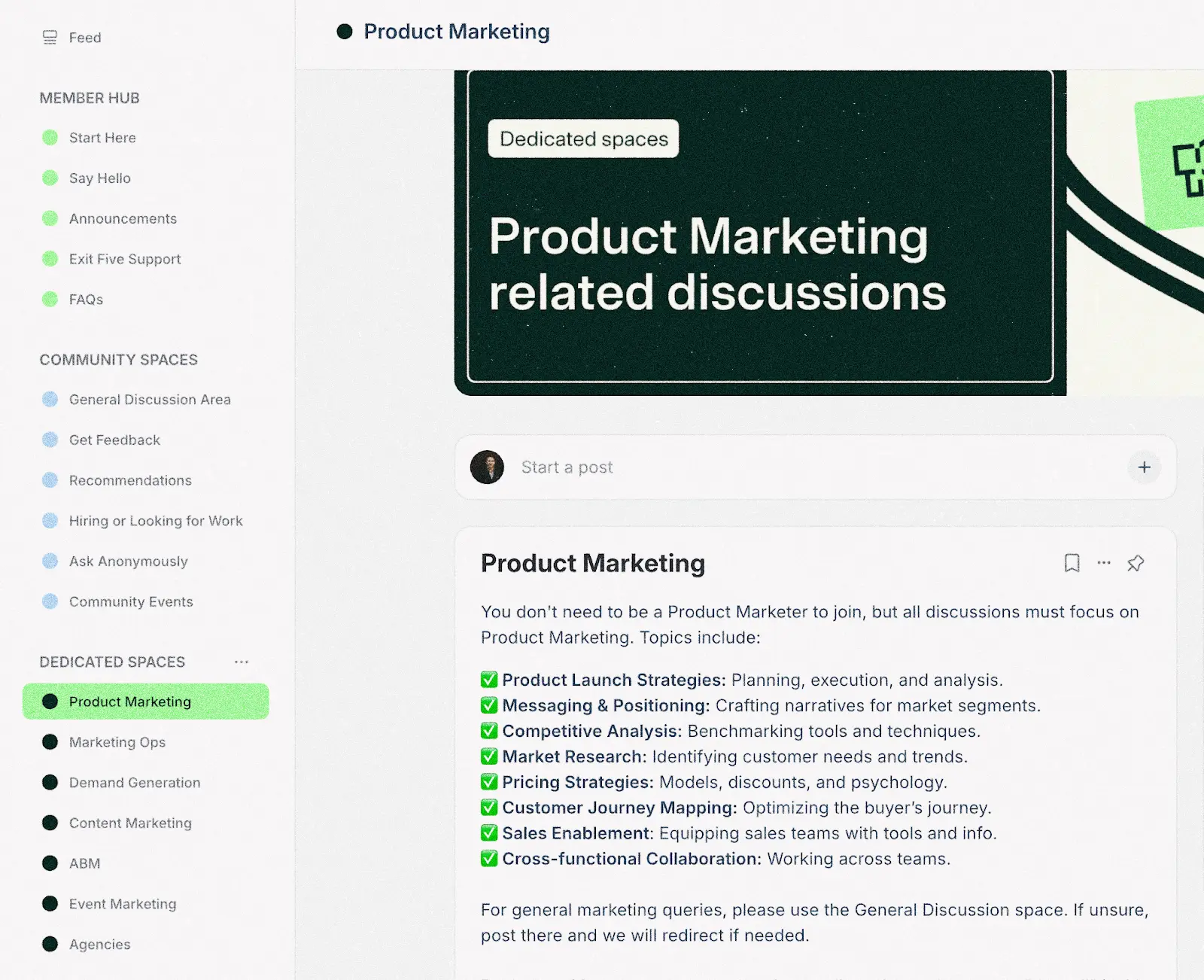
Networking opportunities extend beyond casual conversations. The platform includes a searchable member directory, DM functionality for private connections, and facilitated introductions through the community team. As well as a matchmaking program, which was launched in July 2024 based on member feedback and pairs members with similar interests or complementary skills for one-on-one conversations [7].
There’s also a sub-community for Marketing leaders that they started working on around August 2024. This was originally known as CMO Club, but it has since renamed to Marketing Leaders Club, and is a private Slack community for those Director-level and above. There's now CMO Council, too. It's an invite-only group for CMOs of $25M+ ARR organizations, where they can connect with curated peer groups of 8-10 and are matched by company size, role, and industry [12].
There are regular events including virtual sessions and webinars (which get around 500-1,000 signups [24] and around 1/3 of those turn up [26]), and increasingly, in-person meetups [6, 19]. These range from tactical deep-dives on specific marketing topics to broader strategic discussions with industry leaders [20]. Their first in-person event, "Drive," sold out 200 tickets in a day and led to plans for multiple in-person events per year [19].
There’s also a job board, providing access to vetted B2B marketing opportunities at companies that community members know and trust [17].

In October 2025, they added geographic communities, too. There are now 30+ local chapters in multiple cities, enabling offline as well as online connection. These chapters include small events across cities, including Atlanta, Austin, London, NYC, Paris, Toronto, and others. They've big plans for this new direction, including "big events... dinners, hikes, rage rooms". It's part of a wider evolution of their strategy to move beyond a discussion board focus, to supporting peer connections and professional development. This also means more roundtables, therapy sessions, and member-led training sessions, too.
Exit Five operates a tiered pricing model that has gone through a number of iterations. Currently, standard membership is $49 per month with the Marketing Leaders Club priced at $99 per month and discounts for annual commitments. They previously had annual-only membership pricing, with standard membership costing $499 per year and then CMO Club at $999 per year [1]. So it seems like rather than stick with annual-only pricing, they now use the 24% higher monthly option to anchor pricing, making their annual plans more appealing. Prices have increased over time, with monthly options previously being offered at $30 per month or $300 annually, for standard, and CMO Club at $79 per month [12].
The premium tier provides access to the broader community plus exclusive spaces, curated peer groups, quarterly training sessions with domain experts, and "marketing therapy" sessions with experienced CMOs [12]. This is a curated experience and just 53% of applicants are accepted [32]. There’s also a team membership plan for 5 members, including leadership access to Marketing Leaders Club, for $2699.
Currently membership comes with a 30-day money back guarantee. However, they previously had a 7-day free trial for quite some time. Trials are pretty rare in paid communities, just 8% have them, but it can be a useful way for potential members to experience the community value before committing to payment [4].
Exit Five doesn’t just generate income from memberships, though (40%). They also have revenue streams from sponsorships (50%+), the job board (2%), events, and training programs, too [6]. They include courses like the AI Playbooks course, which they charge $599 for to members ($799 for non-members) [39]. There’s also the Marketing Leadership Accelerator program, an eight week cohort-based program, priced at $499 for members ($699 for non-members [13]). It’s first instance had over 225 sign ups [27].
Exit Five has an open application process, so you can sign up directly through the website. This accessibility aligns with Exit Five's mission to serve B2B marketers at all career stages, from individual contributors to executives [1]. However, the paid membership model serves as a natural filter, attracting serious professionals willing to invest in their career development.
For the Marketing Leaders Club premium tier, the application process includes additional screening. Candidates must demonstrate senior marketing leadership roles, specifically in-house positions as CMO, VP, or Head of Marketing. The community explicitly excludes agency owners, consultants, freelancers, or founders from this group so that peers can have candid conversations [12].
Onboarding is systematic but simple, designed to quickly integrate new members into the community culture and help them realize value from their membership. The process begins with a self-directed onboarding experience that guides members through platform navigation and community norms, including [25]:
New member introductions play a central role in the onboarding flow. Each new member has the opportunity to introduce themselves to the broader community, typically receiving warm welcomes from other members, helping to break the ice [12].
The community team actively facilitates early member experiences through direct outreach and connection suggestions [4]. Matt Carnevale, Head of Community, monitors new member activity and proactively reaches out to ensure members understand how to navigate the platform and find relevant discussions [4].
For Marketing Leaders Club members, the smaller cohorts provide more intimate networking opportunities and regular touchpoints beyond the broader community discussions [12]. The community team uses data from member profiles and early activity to suggest relevant discussion topics, introduce members to subject matter experts, and highlight resources that match their interests [4].
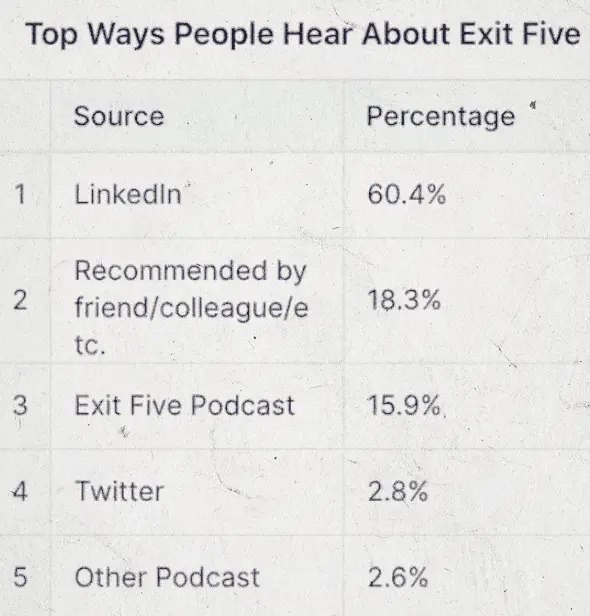
Exit Five's growth strategy centers on a simple but powerful principle: making existing members so happy that they naturally become advocates for the community [25]. That’s powered by a content flywheel, primarily on LinkedIn, which drives ~60% of signups [28]. The team maintains a strong presence on LinkedIn across multiple accounts with a combined following of ~300,000 [16]. This approach reflects Dave's belief that LinkedIn should be the primary 'PR' channel for any B2B startup [16].
The growth model operates on a "curate, don't create" philosophy [6]. Rather than producing entirely original content on all platforms, Exit Five leverages conversations from the community, podcast episodes, and member insights to fuel content creation. Dave explains [6]:
"We want to write an article about SEO. Let's go in the community and see what people are saying about SEO. And then we can take that content. We can grab three podcast episodes… we can feed that content and transcripts to, like, ChatGPT or Claude, and edit it."
Content ranges from member spotlights, to tactical marketing advice, industry insights, and behind-the-scenes looks at building Exit Five itself [16]. It’s all about creating FOMO (fear of missing out). They leap on success stories from members finding new roles or advancing their careers, sharing them widely as social proof, which encourages referrals [17]. Member referrals contribute around 20% to growth.
The LinkedIn strategy involves multiple team members posting regularly, creating what they call "omnipresence" [16]. When team members post consistently, their audience "feels like you're everywhere," creating an echo chamber effect for B2B marketers [16]. This multi-account approach also expands reach beyond any single person's network, although as of Nov 2025, Dave alone has 191k followers, with his founder brand driving significant awareness for Exit Five [16]. Collectively they get over 2 million impressions a month on LinkedIn [24].
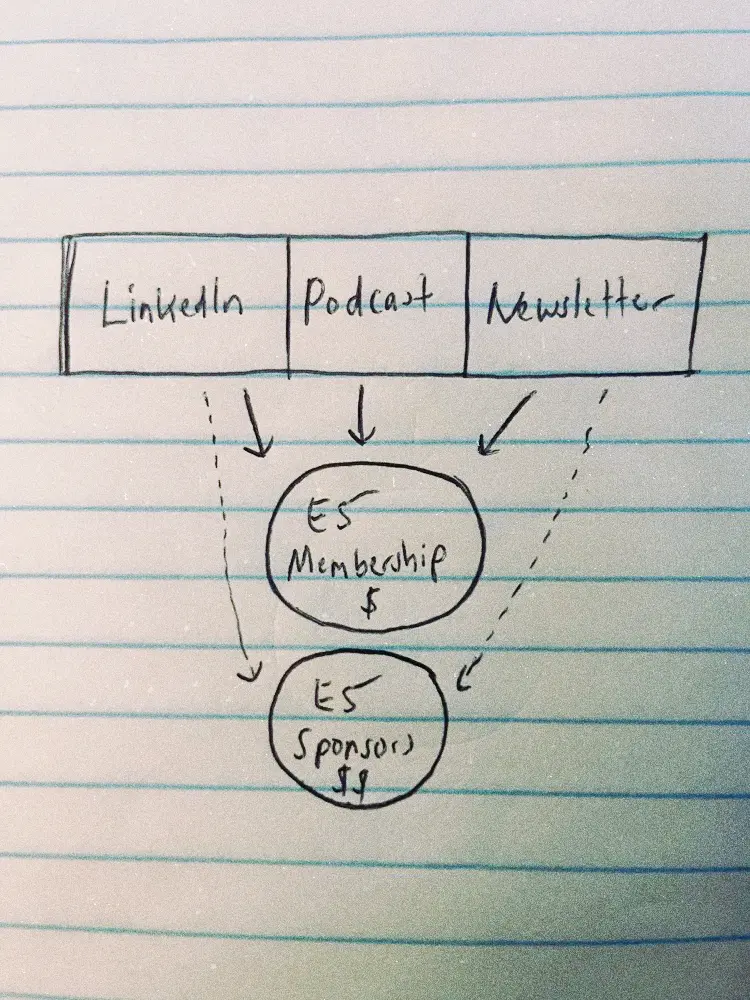
Email marketing through their newsletter reaches over 50,000 subscribers (up from 18k in early 2024) [27] and serves as both a content distribution channel and community recruitment tool [8]. The newsletter brings together their curated content, reinforcing the value proposition while driving member engagement [8].
Similarly, events serve as both member value and acquisition channels [19,20]. Virtual sessions often attract non-members who experience Exit Five's quality firsthand [20]. In-person events create stronger connections and generate content for social media amplification.
There’s a podcast, too. Now called The Exit Five CMO Podcast, it was previously known as "B2B Marketing with Dave Gerhardt." They have produced over 300 episodes [27] and it's on target to hit 1M downloads in Q4 2025. It serves as a top-of-funnel content channel, although, podcast guests often become community members or refer their networks, too [6].
All of these channels are tracked and they take a data-driven approach to optimizing their efforts [23]. Beyond basic signup numbers, they monitor trial conversion rates, member engagement levels, and revenue metrics by acquisition channel [8].
.webp)
The result is consistent member and revenue growth, growing to 5,700 members (67% are US-based [30]). Perhaps most impressive, though, is that they’ve improved MAUs as they’ve grown and they’ve been chipping away at decreasing churn, too. MAUs increased by 71% in the first half of 2024, for example [35]. Removing the ability for members to self-promote, moving from general discussion spaces to topic-specific areas like demand gen, ABM, content, etc. as well as running regular member-exclusive events all contributed to the increase, says Matt [34].
From public mentions we can estimate member growth looks like the following:
.png)
In August 2025, Exit Five announced a shift to create industry-specific subgroups, too. These include FinTech, HealthTech, HR, Manufacturing, MarTech, and others. This expansion significantly broadens their total addressable market and sets them up for greater growth potential in the future.
Initially Exit Five was a side project. Dave worked on Exit Five solo (with some contractors) from 2021 to 2023 before hiring full-time teammates. He used to extol the virtues of solopreneurship—working 15-20 hours a week, work-life balance, time to hang out with the kids, etc. [36]. But the grind of it caught up with him [37]:
“Solopreneurship was great, but ultimately it was golden handcuffs for me. The business was 100% reliant on me. If I wanted to grow, I had to do something personally.“
Now Exit Five operates with a lean team of six full-time employees. He did $800k in revenue running solo in 2023 [31], but by September 2024, they passed $200k revenue in a single month [29]. With the team in place, Dave expects to get to "$3 million to $5 million… in the next one to two years" [6].
Dave remains actively involved in community discussions, content creation, and strategic direction [2]. His daily presence in the community helps maintain the culture and personal connection that members value. Dave also posts regularly on LinkedIn and hosts the podcast, remaining the primary face of the brand [18].
Dan Murphy joined as Chief Operating Officer in November 2023, an old colleague of Dave's from their time together at Drift and Privy [14]. There’s Head of Community, Matt. A former member of the Exit Five community, he is responsible for day-to-day community operations, member engagement, and platform management [4].
His approach is to treat "community like a product, not just a channel," and implement systems to drive engagement and optimize member experience. He uses these systems to facilitate connections between members, and ensure discussion quality remains high. Under his leadership, Exit Five has achieved 40% monthly active users, placing it in the top 1% of Circle communities [4].
Danielle Messler leads content operations as Head of Content, managing the podcast production, newsletter creation, and content curation across platforms. The content team also handles sponsor integrations [19].
Anna Vermillion, Marketing Manager, manages day-to-day logistics and member support. While Allison Saxon, a Marketing Specialist, handles growth initiatives and partnerships.
Hiring decisions prioritize cultural fit and community understanding not just pure technical skills. So they’ve hired slowly, and thoughtfully. "Hire when channels are working,” says Dave. “Ride momentum, don't hire someone to 'figure it out'" [6]. Dave emphasizes finding team members who understand B2B marketing challenges firsthand and can contribute to community discussions so that the team can provide genuine value to members rather than just administrative support.

The core of Exit Five's tech stack runs on Circle, which provides native web and mobile apps, discussion forums, member directories, and basic analytics [5]. The CMO Council includes a private Slack. For events, they use Zuddl, a platform specifically designed for virtual events and webinars [19]. This integration allows Exit Five to create professional event experiences with registration management, branded landing pages, and attendee analytics [19].
The matchmaking program is powered by Matcha [28], while the job board operates on Niceboard. This provides employer self-service posting, candidate filtering, and revenue management. So Exit Five can offer job posting services without building custom functionality [17], and payment processing runs through Stripe, handling both membership subscriptions and one-time purchases for courses and events [9].
Content production leverages several tools, including Hatch.fm for podcast editing, distribution, and show notes creation [33]. Exit Five also uses Clay for contact enrichment, helping them scale sponsorship revenue by enriching their newsletter subscriber data with job titles, company size, and geographic information [41].
So there you have it, that’s how Exit Five went from LinkedIn fame to a million-dollar community.
Niche beats broad appeal. Exit Five's focus exclusively on B2B marketers, rather than all marketers or all business professionals, enables them to deliver highly relevant value. So go deep before you go wide.
Paid communities create better experiences. The decision to charge for membership isn't just about revenue, it fundamentally changes member behavior and community culture. Paying members participate more actively, provide higher-quality contributions, and respect community guidelines, a big reason why their MAUs are so high.
Content curation scales better than content creation. Exit Five's "curate, don't create" philosophy allows them to scale content production efficiently with a small team. There’s a ton of value being created by members everyday. Capturing and sharing some of that can take your content strategy a long way.
Treat community like a product. This means continuously gathering member feedback, implementing improvements, and optimizing for member value rather than just growth.
"I'm not trying to build a billion-dollar company," Dave explains. "I'm trying to build a great business that serves its members exceptionally well while allowing me to maintain balance in my life" [10]. So far, they’re nailing it ✌️

Gareth has spent 15 years in founding marketing roles at community-led startups. He shares his learnings through deep dives.